IELTS Writing Task 1 Process Diagram

An IELTS Writing Task 1 process diagram shows the stages of how something is made or how something happens in nature, and you describe every stage in order. Write an introduction, an overview that says how many stages there are and where the process starts and ends, then two body paragraphs that walk through the stages, mostly in the passive for man-made processes.

Check my process diagram report

A practice IELTS process diagram

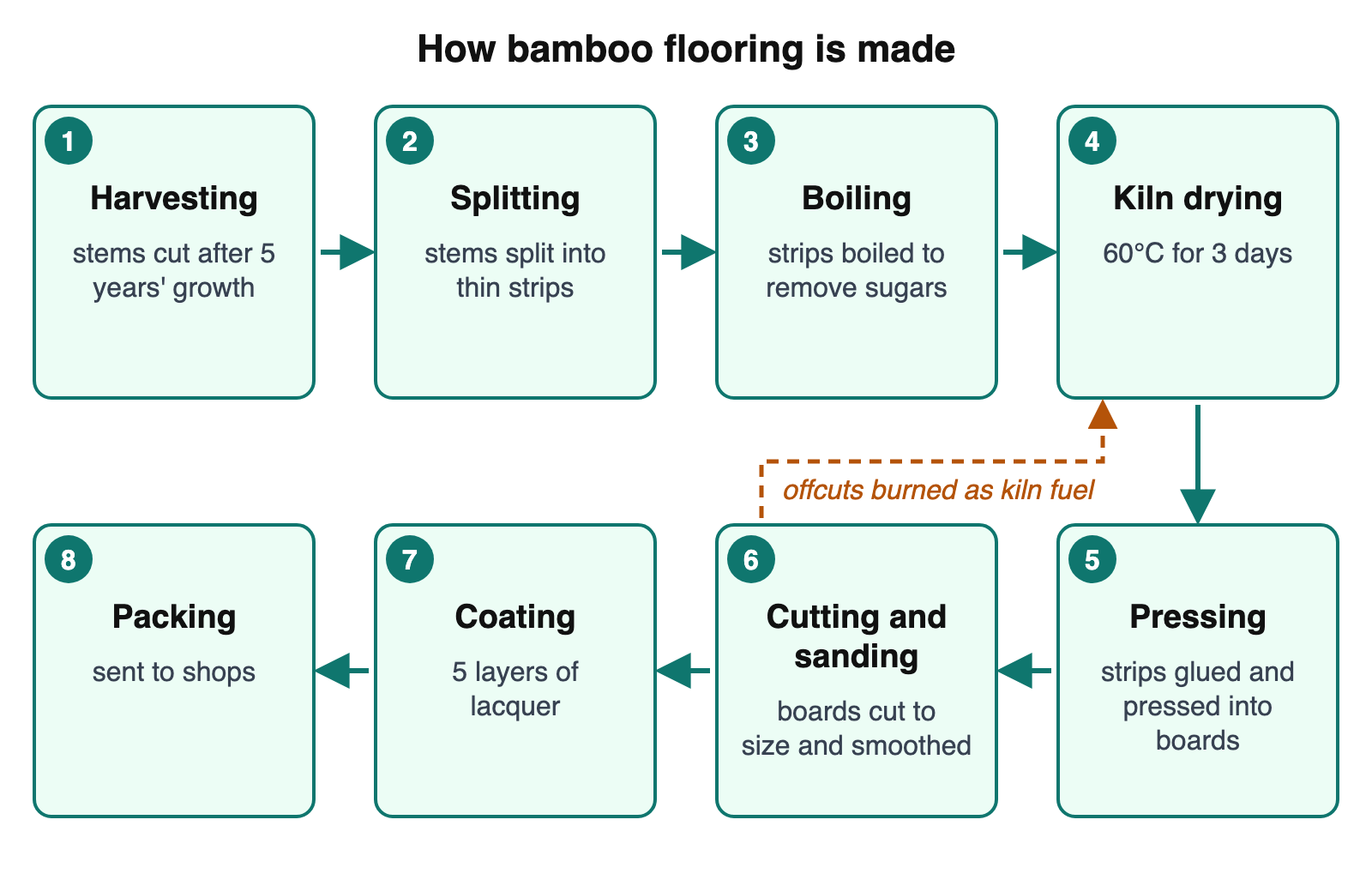
The diagram below shows how bamboo flooring is made. Summarise the information by selecting and reporting the main features, and make comparisons where relevant. Write at least 150 words.

Process diagram of how bamboo flooring is made, in eight stages: 1 harvesting, stems cut after 5 years' growth; 2 splitting into thin strips; 3 boiling to remove sugars; 4 kiln drying at 60°C for 3 days; 5 pressing, strips glued and pressed into boards; 6 cutting and sanding; 7 coating with 5 layers of lacquer; 8 packing, sent to shops. A dashed arrow shows offcuts from stage 6 burned as fuel for the kiln at stage 4.
Original practice diagram, not a real test question. Tap the picture to see it full size.

Give yourself 20 minutes and write at least 150 words before you read the samples below.

How to structure a process diagram report

Before writing, spend two minutes on the diagram: count the stages, find the first and last, and check whether it is a straight line or a cycle that returns to the start. Then follow this plan.

ParagraphWhat goes in itFor the bamboo diagram
IntroductionOne sentence: what the diagram shows, in your own words.The stages involved in manufacturing bamboo flooring.
OverviewTwo sentences, no details: how many stages, where it starts and ends, man-made or natural, straight line or cycle, and anything unusual.Eight stages, from cutting the stems to packing; stems become strips, then boards; offcuts go back to the kiln.
Body 1The first half of the stages, in order, with the details the diagram gives.Stages 1 to 4: harvesting to kiln drying (60°C, three days).
Body 2The rest, in order, to the end.Stages 5 to 8: pressing to packing, and where the offcuts go.

Task 1 doesn't need a conclusion. Put the overview straight after the introduction, where it's easiest to find. If the diagram splits into two branches, or something is reused, mention it in the overview and again where it happens.

Passive voice and sequencing words for process diagrams

Two language skills matter most in a process report: linking the stages smoothly (Coherence and Cohesion) and forming the passive correctly (Grammatical Range and Accuracy).

JobLanguageExample from the bamboo diagram
StartingThe process begins when… / At the first stage…The process begins when bamboo stems are cut after five years.
Next stepthen, next, after that, following this, subsequentlyFollowing this, the strips are dried in a kiln.
Joining two stagesonce…, after being…, before being…, which are then…Once dry, the strips are glued together and pressed.
Purposeto + verb, in order to, so thatThe strips are boiled to remove their natural sugars.
Detailsat… °C, for… days, after… yearsThey are dried at 60°C for three days.
EndingFinally, / In the final stage, / The process ends with…Finally, the flooring is packed and sent to shops.

The passive is is/are + past participle: the strips are boiled, the boards are sanded. The two most common slips are a missing -ed ("the strips are boil") and a verb that doesn't agree with its subject ("the strips is glued"); both appear in the band 5.5 sample below. In natural processes, use active verbs for things that happen by themselves: eggs hatch, water seeps into cracks, the nymph climbs out.

Use these to link your own sentences, not as memorised lines. A different linking word at the start of every sentence reads as mechanical and doesn't raise your score.

Check your process diagram report

What are you checking?
0 words

1 free check a day, no sign-up. Free account: 2 checks a day.

Private: we never publish your writing or use it to train AI, and you can delete it at any time. Tested on 22 sample answers with published examiner bands: within half a band 63% of the time on Task 1. How we tested

Independent practice tool. Not affiliated with, approved or endorsed by IELTS, the British Council, IDP or Cambridge University Press & Assessment. IELTS is a registered trademark of its owners. Scores are AI estimates, not official results.

IELTS process diagram samples: band 5.5 and band 8

Task: The diagram below shows how bamboo flooring is made. Summarise the information by selecting and reporting the main features, and make comparisons where relevant. Write at least 150 words.

We wrote two reports on the bamboo diagram above, one weaker and one stronger, and scored each once with our AI checker on 2026-11-23, with the diagram picture attached as a test taker would upload it. The bands are AI estimates, not examiner marks (how accurate the checker is).

Band 5.5 answer (152 words)

The diagram illustrate the process of making bamboo flooring. There are eight steps in this process.

First, the bamboo is cut when it is five years old. Then people split the stems into thin strips. After that the strips are boil to remove the sugar. Next step is drying the strips in a kiln, it takes three days at 60°C. So the strips become dry and ready.

After drying, the strips is glued together and pressed so they become boards. Then the boards are cut to the right size and sanding to make it smooth. The small pieces which are cut off is used for the kiln. After this, the workers put five layers of lacquer on the boards. Finally, the flooring is packed and send to the shops.

In conclusion, making bamboo flooring have many steps and it takes a long time, it start from harvesting and end with packing.

CriterionBandChecker's comment
Task Achievement6The report addresses the task and covers the main stages, but the overview is not clear and some details are missing or inaccurate.
Coherence and Cohesion6The report is logically organized with clear progression, but linking is mechanical and the conclusion does not effectively summarize.
Lexical Resource6Vocabulary is adequate for the task but with noticeable word form errors and limited variety.
Grammatical Range and Accuracy5Limited range of structures with frequent errors that make the reader work to understand.
Overall5.5Average of the four, rounded down to a half band.

What held it back

  • No clear overview of the main stages and recycling loop.
  • Frequent grammatical errors (subject-verb agreement, verb forms).
  • Mechanical linking and weak conclusion.

Corrections the checker made

  • The diagram illustrate → The diagram illustrates
    Subject-verb agreement: 'diagram' is singular, so the verb needs -s.
  • the strips are boil → the strips are boiled
    Passive voice requires past participle 'boiled'.
  • to remove the sugar → to remove sugars
    Use plural 'sugars' for general reference; 'the sugar' implies specific sugar.
Band 8 answer (164 words)

The diagram illustrates the stages involved in manufacturing bamboo flooring, from harvesting the plant to delivering the finished product to retailers.

Overall, the process consists of eight steps, in which raw bamboo stems are turned first into strips and then into boards, before these are finished and packed. A notable feature is that waste from one of the later stages is recycled as fuel for an earlier one.

The process begins when bamboo stems are cut after five years of growth. They are then split into thin strips, which are boiled to remove their natural sugars. Following this, the strips are dried in a kiln at 60°C for three days.

Once dry, the strips are glued together and pressed to form boards. These boards are cut to size and sanded until smooth, and the offcuts produced at this stage are burned to heat the kiln. In the final stages, the boards receive five coats of lacquer before being packed and sent to shops.

CriterionBandChecker's comment
Task Achievement8Fully covers the task with a clear overview and accurate reporting of all main stages and key details.
Coherence and Cohesion8Well-organized with clear progression and appropriate use of linking devices.
Lexical Resource8Wide range of vocabulary used accurately and appropriately for the task.
Grammatical Range and Accuracy8Wide range of structures with a high degree of accuracy.
Overall8Average of the four, rounded down to a half band.

What held it back

  • Overview could be slightly more detailed to explicitly mention the two main phases.
  • Minor repetition of 'strips' and 'boards' could be varied.
  • No significant issues; overall a high-quality response.

The checker made no corrections to this report.

What lifts the band 5.5 report to band 8

  • An overview near the start. The band 5.5 report says only "There are eight steps" and saves its summary for a conclusion that adds nothing ("has many steps and it takes a long time"). The band 8 report says in its second paragraph how stems become strips and then boards, and points out that waste from a later stage fuels an earlier one. Task Achievement: 6 against 8.
  • Correct passives. "The strips are boil", "the strips is glued" and "send to the shops" are typical process-report errors. Grammar: 5 against 8.
  • Stages joined, not just listed. Most sentences in the body of the weaker report start with a linking word (First, Then, After that, Next, Finally). The stronger one joins stages inside sentences ("split into thin strips, which are boiled…", "Once dry, the strips are glued…"). Coherence and Cohesion: 6 against 8.
  • Precise words. "Manufacturing", "retailers", "offcuts" and "five coats of lacquer" against "making", "the shops" and "the small pieces which are cut off". Lexical Resource: 6 against 8.

Process diagram mistakes that cost the most marks

  • No overview, or a conclusion that repeats the stages. Say something about the whole process (how many stages, how it starts and ends) in an overview after the introduction.
  • Skipping stages. A chart lets you choose the key figures; a process doesn't. Leaving out a stage weakens Task Achievement.
  • Broken passives. Check every "is/are" has a past participle after it, and every verb agrees with its subject.
  • Copying the labels. "Kiln drying 60°C 3 days" is a note, not a sentence. Turn each label into a full sentence in your own words.
  • Explaining or judging the process. "This is good for the environment" is your opinion, not something the diagram shows.
  • The passive for natural processes. "The eggs are hatched" is wrong when nothing hatches them; things that happen by themselves take active verbs.

Other Academic Task 1 types have their own practice pages: line graph, bar chart, pie chart, table and map. For what each band needs, read the Task Achievement band descriptors, explained.

8 more IELTS process diagrams to practise

Original diagrams in the style of the test, man-made and natural, straight-line and cycles. Tap a button to put the diagram and its task into the checker, then write your report.

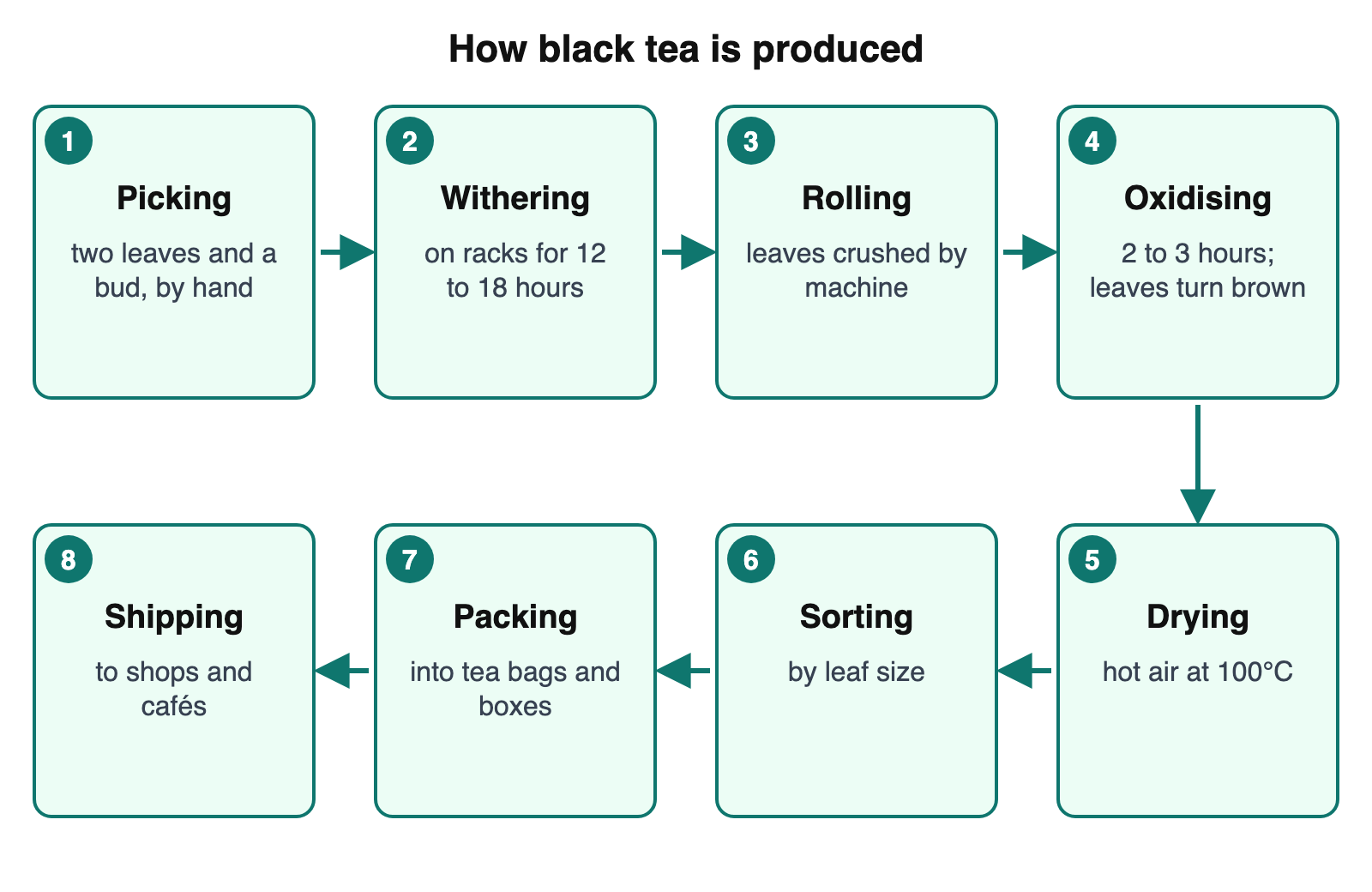
  1. Man-made, 8 stages The diagram below shows how black tea is produced.

    Eight stages of black tea production: picking two leaves and a bud by hand; withering on racks for 12 to 18 hours; rolling, leaves crushed by machine; oxidising for 2 to 3 hours as leaves turn brown; drying with hot air at 100°C; sorting by leaf size; packing into tea bags and boxes; shipping to shops and cafés.

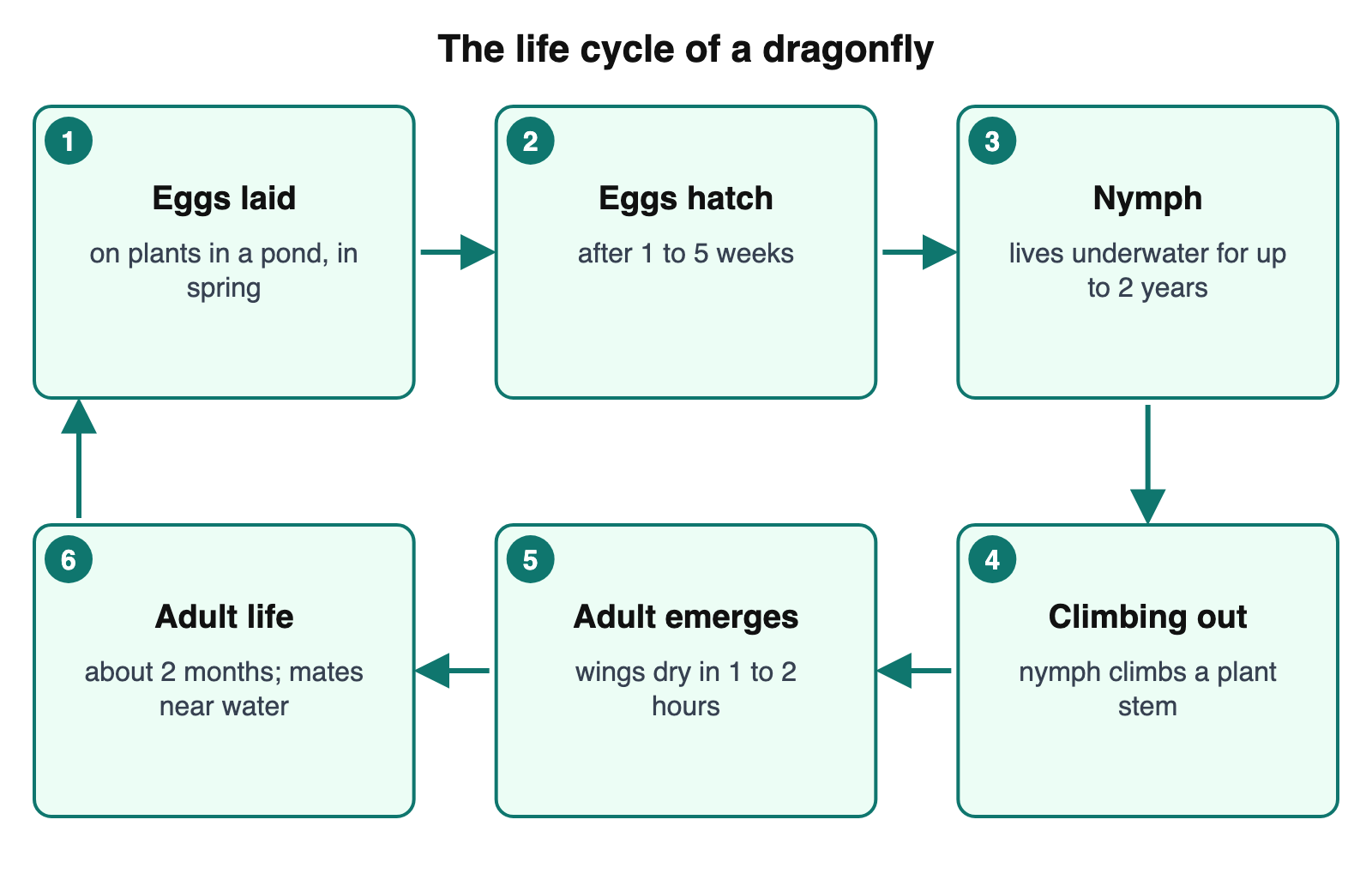
  2. Natural cycle, 6 stages The diagram below shows the life cycle of a dragonfly.

    Six stages in a cycle: eggs laid on plants in a pond in spring; eggs hatch after 1 to 5 weeks; the nymph lives underwater for up to 2 years; it climbs out of the water up a plant stem; the adult emerges and its wings dry in 1 to 2 hours; the adult lives about 2 months and mates near water, which leads back to eggs being laid.

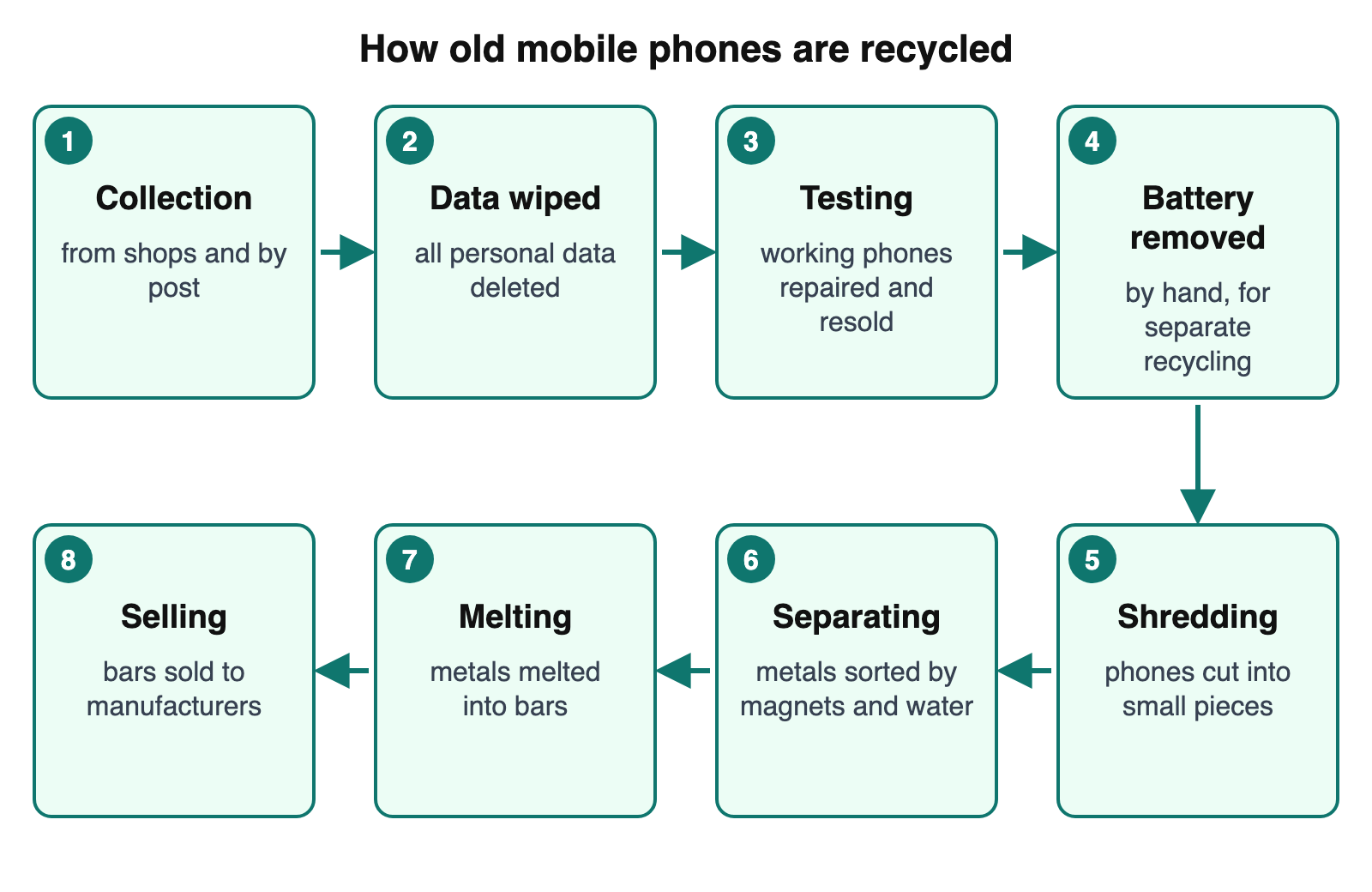
  3. Man-made, 8 stages The diagram below shows how old mobile phones are recycled.

    Eight stages of mobile phone recycling: collection from shops and by post; data wiped; testing, where working phones are repaired and resold; battery removed by hand for separate recycling; shredding into small pieces; separating metals with magnets and water; melting the metals into bars; selling the bars to manufacturers.

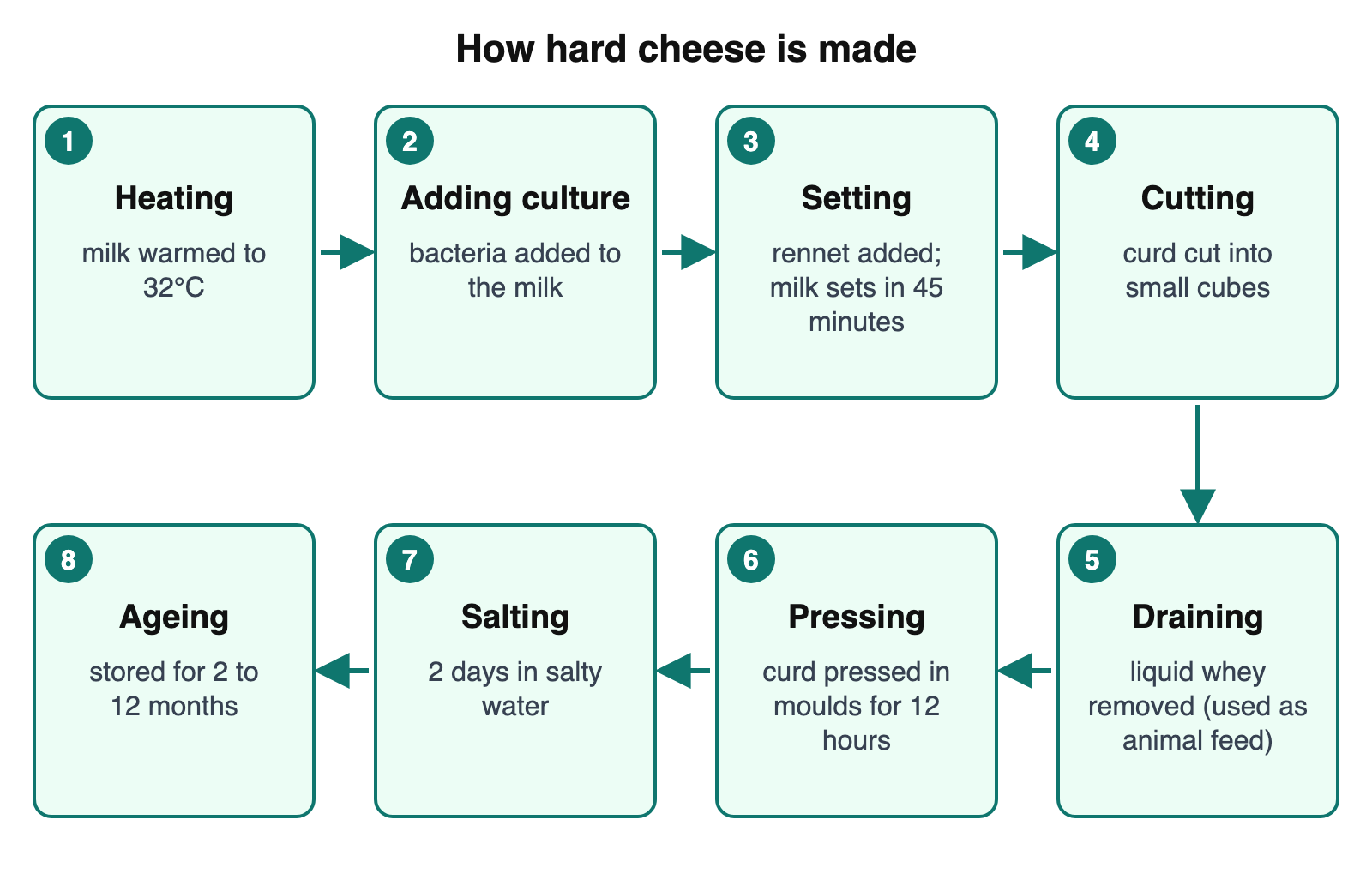
  4. Man-made, 8 stages The diagram below shows how hard cheese is made.

    Eight stages of hard cheese making: milk heated to 32°C; bacteria culture added; rennet added and the milk sets in 45 minutes; the curd is cut into small cubes; the liquid whey is drained and used as animal feed; the curd is pressed in moulds for 12 hours; salted for 2 days in salty water; stored for 2 to 12 months.

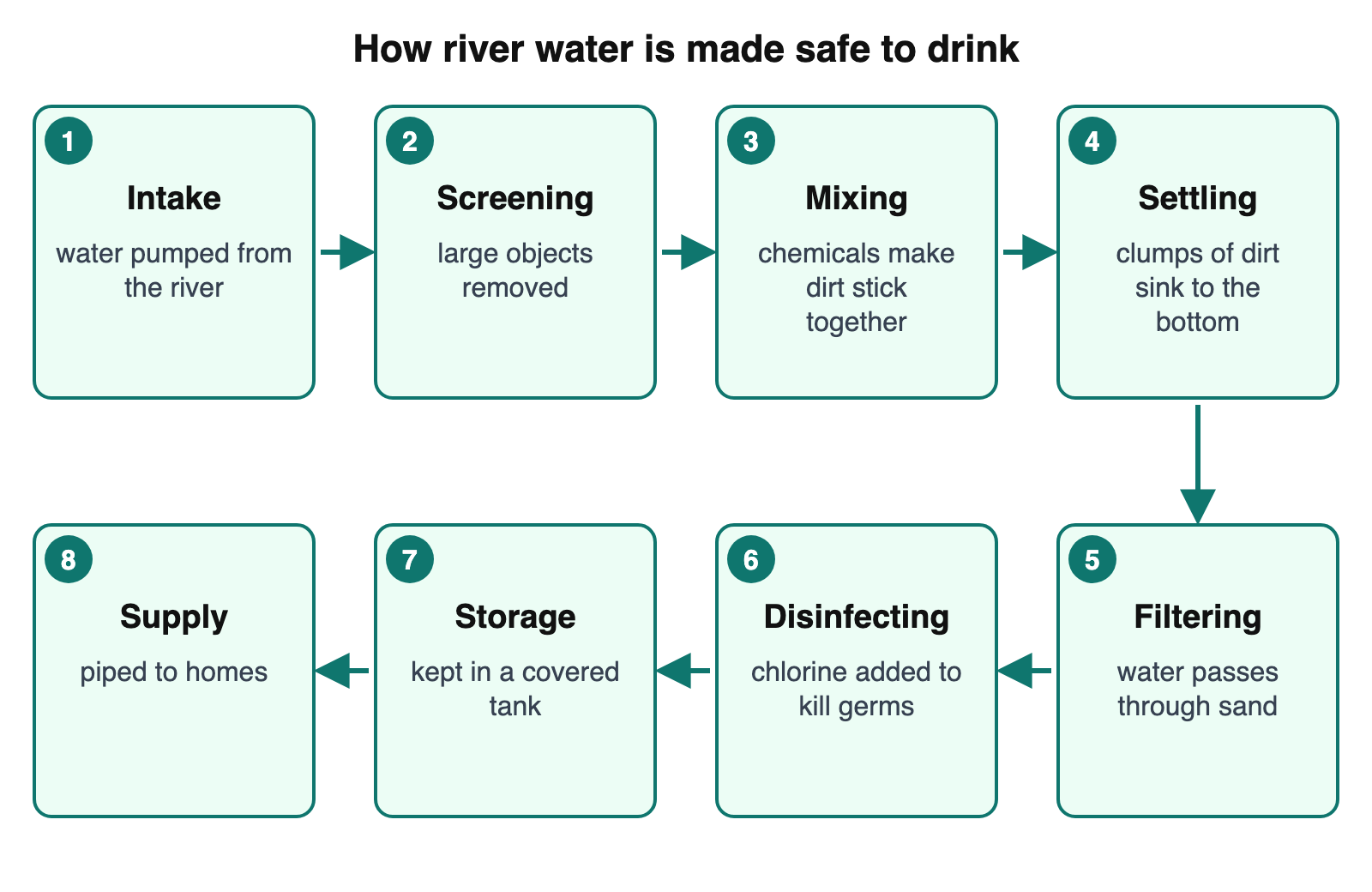
  5. Man-made, 8 stages The diagram below shows how river water is made safe to drink.

    Eight stages of water treatment: water pumped from the river; screening removes large objects; chemicals make dirt stick together; clumps of dirt sink in a settling stage; the water passes through sand; chlorine is added to kill germs; storage in a covered tank; supply by pipe to homes.

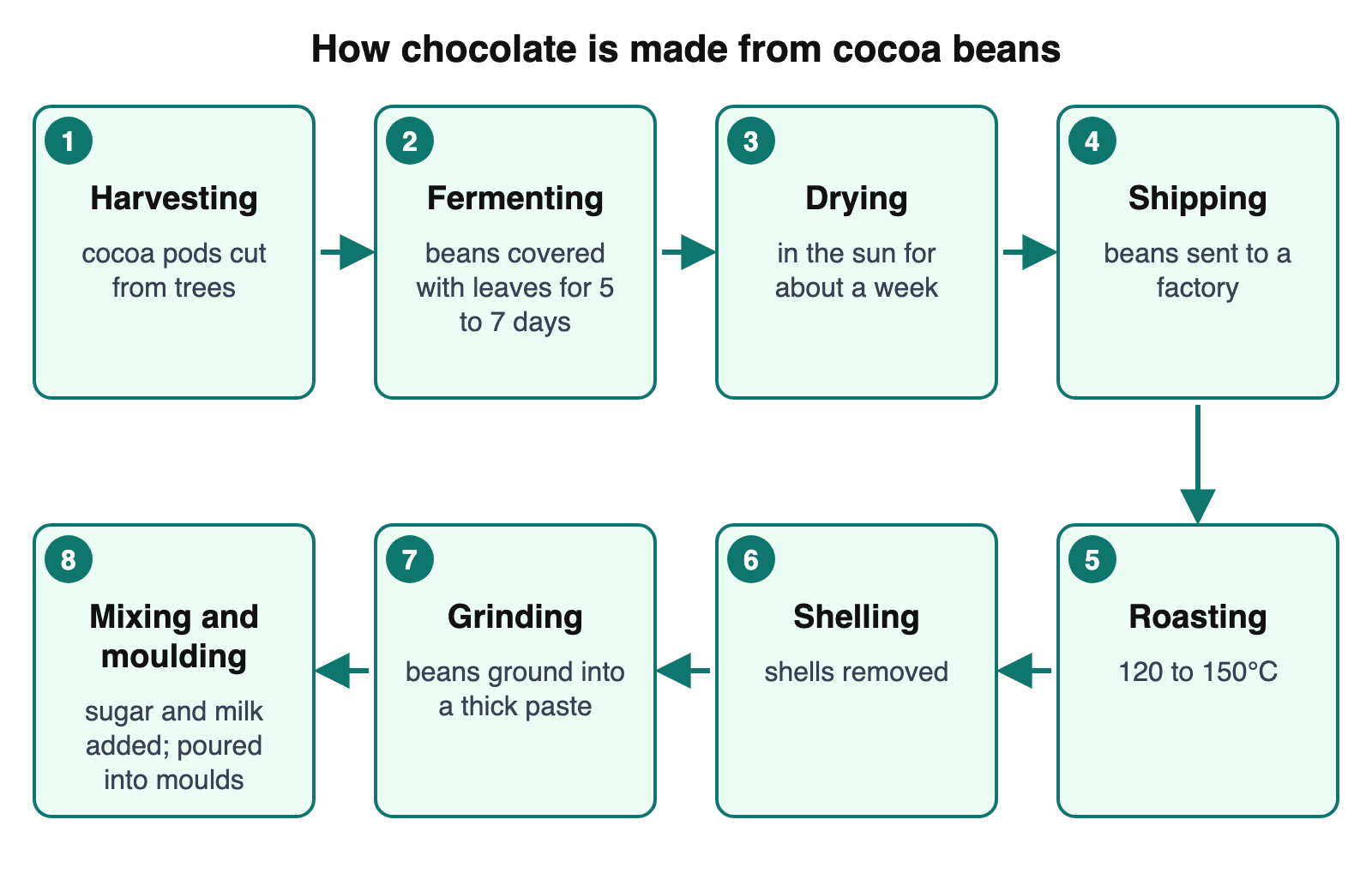
  6. Man-made, 8 stages The diagram below shows how chocolate is made from cocoa beans.

    Eight stages of chocolate making: cocoa pods cut from trees; beans fermented under leaves for 5 to 7 days; dried in the sun for about a week; shipped to a factory; roasted at 120 to 150°C; shells removed; ground into a thick paste; sugar and milk added and the mixture poured into moulds.

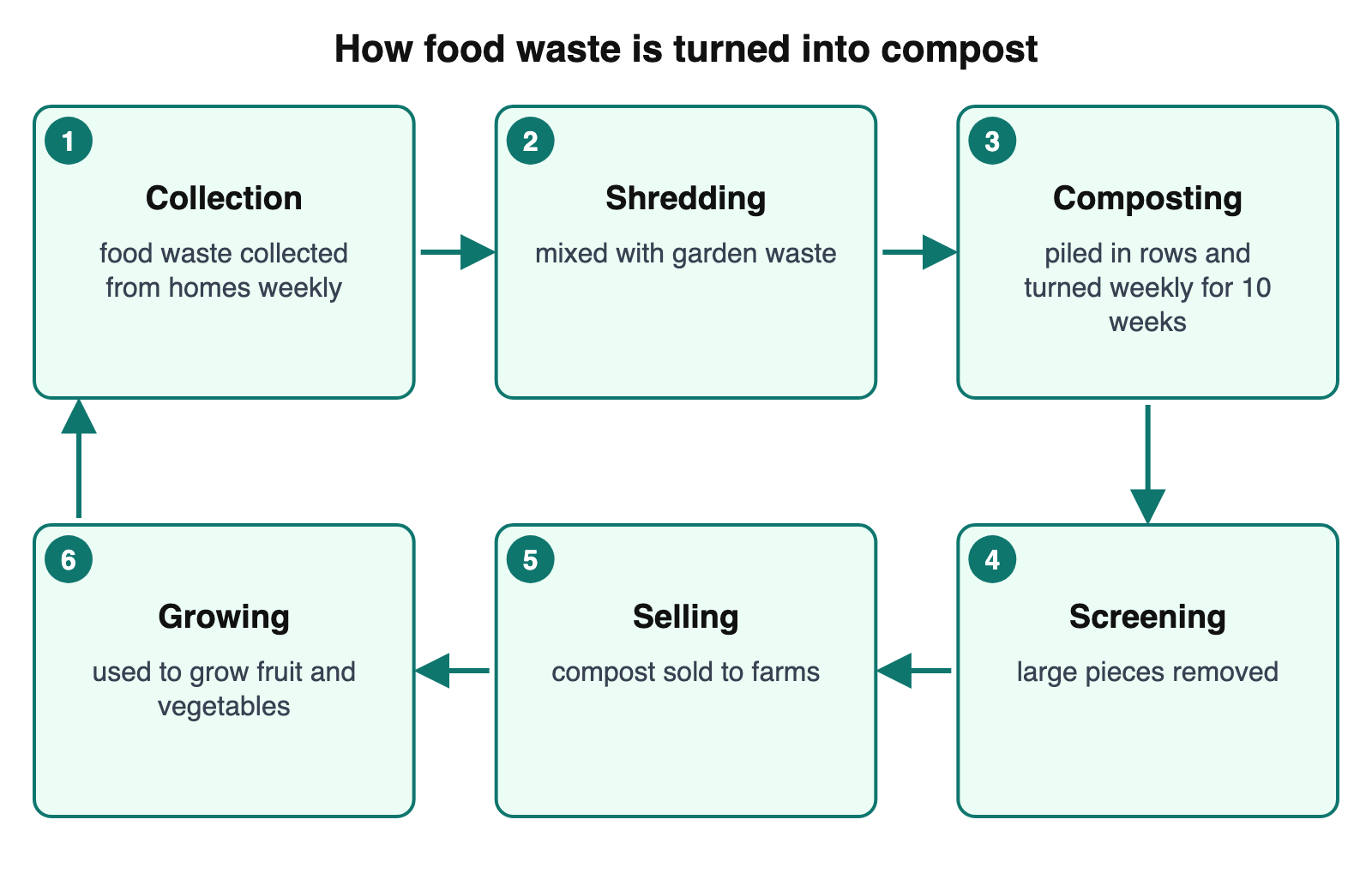
  7. Man-made cycle, 6 stages The diagram below shows how food waste is turned into compost.

    Six stages in a cycle: food waste collected from homes weekly; shredded and mixed with garden waste; piled in rows and turned weekly for 10 weeks; screened to remove large pieces; compost sold to farms; used to grow fruit and vegetables, which leads back to food waste.

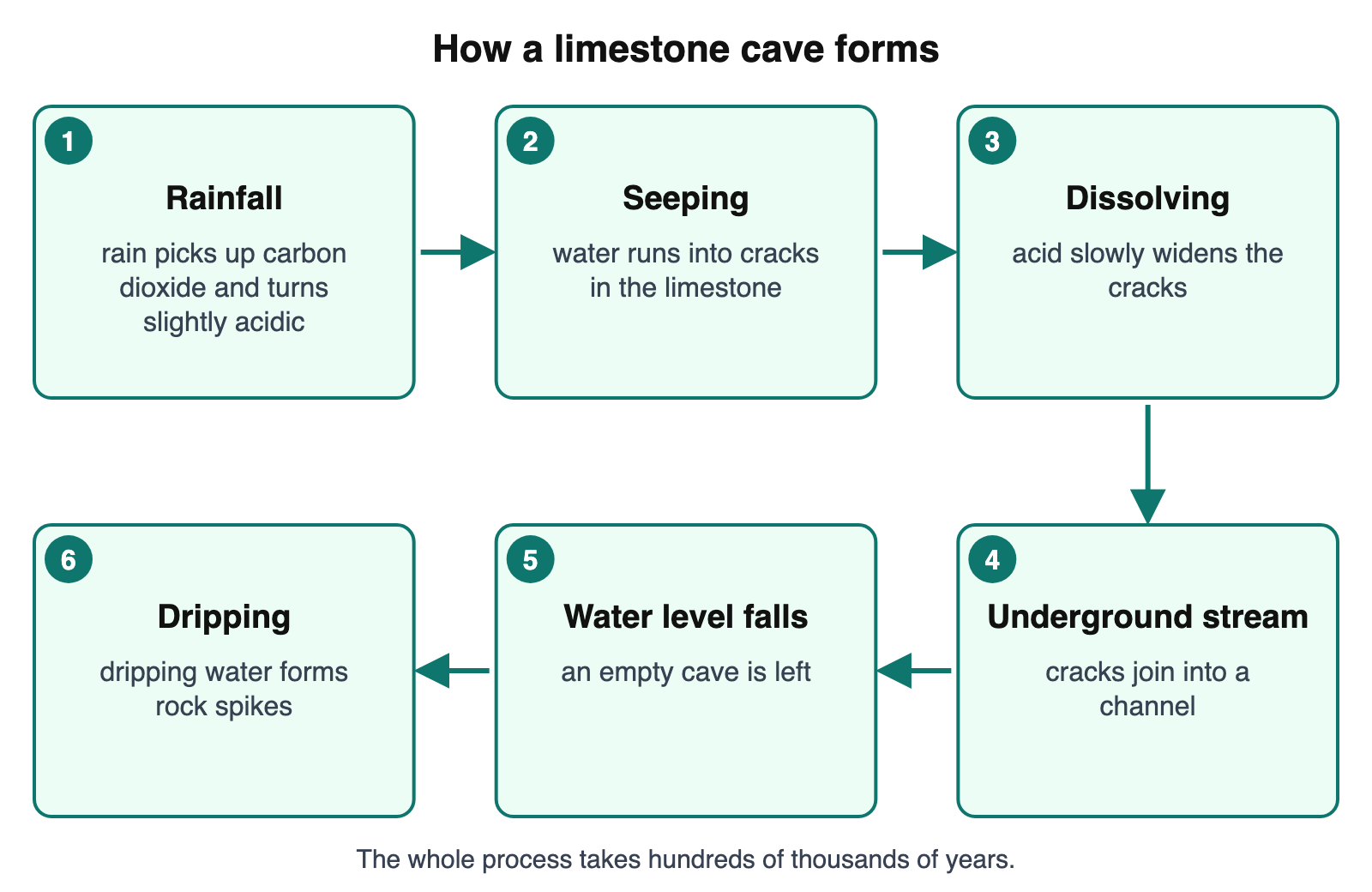
  8. Natural, 6 stages The diagram below shows how a limestone cave forms.

    Six stages of cave formation, taking hundreds of thousands of years: rain picks up carbon dioxide and turns slightly acidic; water runs into cracks in the limestone; the acid slowly widens the cracks; the cracks join into an underground stream channel; the water level falls and leaves an empty cave; dripping water forms rock spikes.

Have a diagram from a practice book? Upload a photo or screenshot of it on the Task 1 checker.

Questions

How do you write a process diagram in IELTS Writing Task 1?
Write four paragraphs: a one-sentence introduction that paraphrases the task, an overview that says how many stages there are and where the process starts and ends, and two body paragraphs that take the stages in order, roughly half each. Use the passive for man-made processes and sequencing words to join the stages.
Does a process diagram need an overview?
Yes. A report with no clear overview rarely scores above band 5 or 6 for Task Achievement, however well it describes each stage. Say how many stages there are, what the first and last stages are, and whether the process is a straight line or a cycle. Don't add details or numbers there.
Should I use the passive voice in a process diagram?
For man-made processes, mostly yes, because what matters is what happens to the material, not who does it: "the strips are boiled". Natural processes often use active verbs instead, because many of them can't be passive: "the eggs hatch", "water seeps into the rock".
Do I have to mention every stage?
Yes. Unlike a chart, a process diagram has no minor figures to leave out: each stage is part of the process, so cover them all briefly, with key details such as temperatures and times.
How many words should a process diagram report have?
At least 150. Between 160 and 190 is a safe target in 20 minutes: enough to cover every stage without padding. The band 8 sample above is 164 words.
Can I check my process diagram report for free?
Yes: 1 check a day without signing up, or 2 a day with a free account. Upload the diagram, paste your report, and you get a band for each criterion and the 3 most serious corrections. The checker reads the stages from the picture, so it can check your report against them.